I’m somewhat of an art-nut. Painting is my hobby, and I’m always interested in anything that has to do with art. I have never sold a single piece of art in my life, so I tell my husband that I’m neck and neck with Vincent van Gogh in the race, since he only sold one.
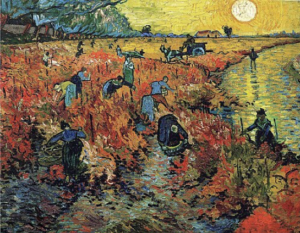
He sold The Red Vineyard to Anna Boch (another artist), the sister of his friend Eugene Boch.
I found out all this from a documentary that featured the Impressionists. (They included Vincent, even though, technically, he’s a post-Impressionist.) And then my chin dropped when the presenter said that Vincent’s sister-in-law saved his legacy, and that without her we might not even know about his art. Whaaat? How had my art-nut, nerdy little self never heard about this?
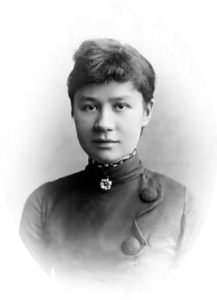
Down the rabbit hole I went with research, discovering that in fact, Theo van Gogh proposed to her after meeting her just twice! (We’ll give this to Theo, he knew a good woman when he saw one.) After they got married in 1889, she moved to Paris with him from Amsterdam.
Theo pretty much financed Vincent’s life, buying his canvases, paints, and even his pouch of tobacco. He believed in his older brother with all his heart. Unfortunately, Vincent was never able to achieve success. He died the year after Theo and Johanna got married. Theo passed away six months after Vincent, leaving Johanna alone with a brand-new baby in Paris, where she barely spoke the language.
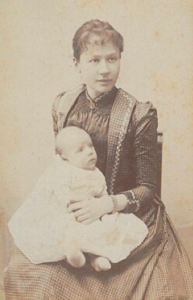
Theo inherited Vincent’s art, and when he died so soon after, the hundreds of paintings, drawings, and letters were left to Johanna. Unfortunately, they were worth next to nothing. She had no training or experience in art, but she believed in Theo, and Theo had believed in Vincent. So instead of discarding the paintings before taking the train back to the Netherlands with her son, she took them along to Bussum, where she started running a boardinghouse. And then she spent the rest of her life making sure that Vincent’s talent would not be forgotten.
To introduce Vincent to the world, she published the brothers’ correspondence. She also tirelessly worked to exhibit the paintings, fighting on despite countless rejections and criticism.
“Mrs Van Gogh is a charming little woman, but it irritates me when someone gushes fanatically on a subject she knows nothing about, and although blinded by sentimentality still thinks she is adopting a strictly critical attitude. It is schoolgirlish twaddle, nothing more. […] The work that Mrs Van Gogh would like best is the one that was the most bombastic and sentimental, the one that made her shed the most tears; she forgets that her sorrow is turning Vincent into a god.” Wrote Dutch artist Roland Holst about her in the Museumjournaal.
Source: J. M. Joosten, “Van Gogh publicaties,”
Museumjournaal 15, no. 3 (1970), 157–58.
So you know what Johanna did? She refused to give up! She even translated Vincent and Theo’s letters into English, and travelled to New York to exhibit his work and introduce him to an American audience.
After her death, her son, also named Vincent van Gogh, carried on the work and founded the Van Gogh Museum in Amsterdam.
So, obviously, I had to write a book about her. She was an amazing woman history shouldn’t have forgotten.